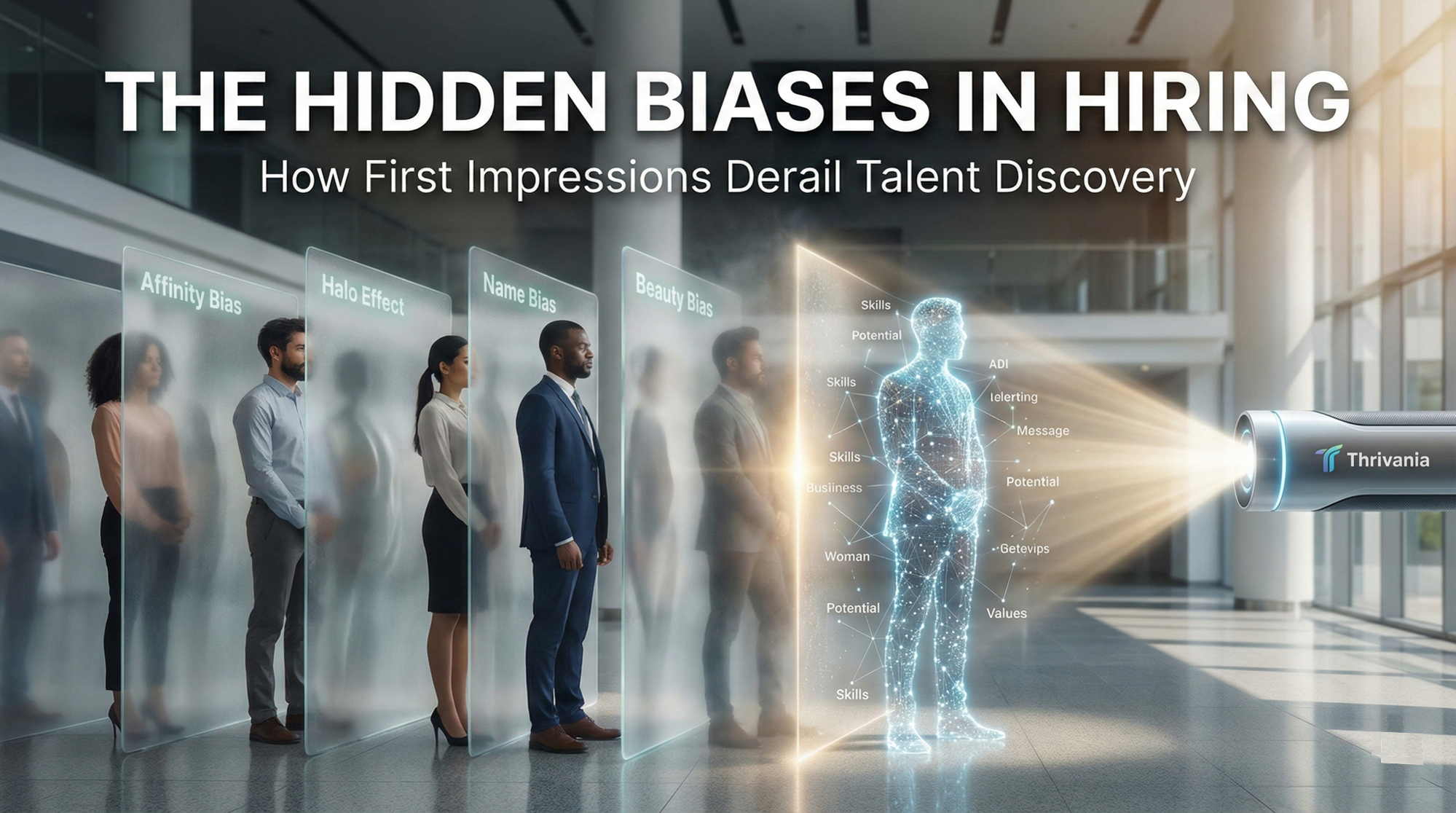
The initial stages of hiring are often riddled with unconscious biases that can prevent qualified candidates from ever reaching an interview. These biases, rooted in our natural human tendency to categorize and prefer familiarity, can severely limit diversity and lead to suboptimal hiring decisions. Thrivania is engineered to dismantle these barriers, ensuring every candidate is evaluated on their true potential.
Common Hiring Biases and Their Impact
Several biases frequently derail fair talent discovery:
- Affinity Bias: Favoring candidates who share similar backgrounds, interests, or experiences. This leads to homogeneous teams.
- Halo Effect: Allowing one positive trait (e.g., impressive alma mater) to overly influence the overall perception of a candidate, overshadowing other important qualities.
- Horn Effect: The opposite of the halo effect; letting one negative trait (e.g., a minor typo) overshadow all other positive qualities.
- Beauty Bias: Giving preferential treatment to physically attractive candidates, which has no correlation with job performance.
- Confirmation Bias: Seeking information that confirms pre-existing beliefs about a candidate while ignoring contradictory evidence.
- Name Bias: Making assumptions about candidates based on their names, which can reflect ethnicity, gender, or socioeconomic background, leading to unfair screening.
- Similarity-Attraction Bias: Preferring people who are similar to ourselves in demographics, values, or working style, hindering diversity.
These biases collectively create a bottleneck, preventing diverse and highly capable individuals from progressing, ultimately limiting an organization's potential.
Thrivania's Solution: A Bias-Free Hiring Funnel
Thrivania directly addresses these biases through its core features, aligning with its mission to "democratize opportunity by revealing human potential" and its value of "Fair Assessment":
1. Anonymized & Skills-Based Profiling
Our AI-powered conversational onboarding focuses on skills, potential, and cultural fit, not traditional resume data. This blind initial assessment neutralizes name bias, beauty bias, and affinity bias by removing identifying information and subjective first impressions.
Impact: Candidates are judged on merit, not superficial characteristics. Employers gain access to a wider, more diverse talent pool.
2. Challenge-Based Assessments
Candidates demonstrate their actual capabilities through real-world challenges. This objective evaluation directly counters the halo and horn effects, as performance is measured concretely, not based on a single impressive or unimpressive trait.
Impact: True potential is revealed. Employers make decisions based on proven ability, leading to better hires and reduced turnover.
3. Structured & Objective Matching
Thrivania's intelligent matching algorithms prioritize objective compatibility factors like skills, values, and working styles. This structured approach minimizes confirmation bias and similarity-attraction bias by focusing on data-driven insights rather than subjective interviewer preferences.
Impact: Fairer matches lead to higher retention and more cohesive, diverse teams that align with Thrivania's vision of "a world where everyone has the opportunity to thrive."
Conclusion: Building a Truly Meritocratic Future
By systematically addressing these hidden biases, Thrivania empowers organizations to build stronger, more innovative teams and helps individuals find opportunities where their potential is truly recognized. This commitment to bias-free opportunity is central to Thrivania's promise of "Where Potential Meets Opportunity."
Join Thrivania to experience a hiring process that values who you are and what you can achieve, free from the limitations of unconscious bias.